
Your Questions, Answered
-
Acoustic treatment is the process of improving how sound behaves inside a room.
Every room has its own acoustic personality. Its dimensions, surfaces, furnishings, and construction all influence how sound travels, reflects, builds up, and fades away.
Sometimes those characteristics are desirable. Sometimes they interfere with what we're trying to do.
Acoustic treatment — via analysis, design and build — helps us shape the sound of a room to better suit the work, music, or conversations happening inside it.
-
This is probably the most important distinction we can make.
Acoustic treatment improves the sound within a room. Soundproofing reduces the transmission of sound between rooms or between indoors and outdoors.
They're related, but they involve different techniques and materials.
Acoustic panels can make a room sound dramatically better without significantly reducing the amount of sound that passes through its walls.
If your goal is to stop your neighbours from hearing your drums, that's primarily a sound-isolation challenge. If your goal is to make your drums sound better inside the room, that's an acoustic-treatment challenge.
We're happy to help you understand the difference.
-
You may already be hearing the evidence.
Perhaps conversations sound unusually echoey. Maybe your recordings sound muddy, your studio monitors produce exaggerated bass, or your voice sounds hollow during video calls.
You might notice that certain musical notes seem much louder than others, or that sounds linger unpleasantly after they've stopped.
Sometimes the problems are subtle enough that you don't recognize them until you hear the room after treatment.
A conversation and a few simple observations can often tell us whether treatment is worth exploring.
-
Not unless that's what the room actually needs—and it usually isn't.
The objective isn't to eliminate every reflection or absorb every sound. It's to achieve an appropriate balance for the room's purpose.
A music mixing room generally benefits from a more controlled acoustic environment. A room where people rehearse or play instruments may benefit from retaining some natural liveliness.
A good-sounding room isn't necessarily a quiet-sounding room. It's a room that sounds right for what happens inside it.
-
Sound reflects from walls, ceilings, floors, and other surfaces. Some frequencies are reinforced by those reflections, while others are weakened.
Low frequencies can accumulate in particular parts of a room, creating booming or uneven bass. Hard surfaces can produce excessive reverberation or distinct echoes.
Even a relatively small room can exhibit complicated acoustic behaviour.
The good news is that many of these problems can be substantially improved through thoughtful placement of appropriately designed acoustic treatment.
-
Sometimes they help, and they're often a useful starting point.
Soft furnishings can absorb certain frequencies, while bookshelves and irregular surfaces may scatter some reflected sound.
But ordinary household furnishings generally don't provide the broadband absorption needed to address many acoustic problems, particularly at lower frequencies.
Purpose-built acoustic panels can make a substantial difference where ordinary furnishings fall short.
-
Absolutely not.
While recording studios are a familiar application, acoustic treatment can improve many everyday environments.
Home offices, podcasting rooms, therapy and counselling offices, music practice rooms, editing suites, and small meeting spaces can all benefit.
Anywhere people need to hear clearly, communicate comfortably, or work with sound is worth considering.
-
Yes.
Many home offices weren't designed with spoken communication in mind. Hard walls, bare floors, and reflective surfaces can make voices sound hollow or reverberant — and that can be tiring for your ears and hard on your concentration.
Thoughtfully placed acoustic panels can reduce unwanted reflections and make a room more comfortable for conversation, video meetings, and recording.
Your microphone and conferencing software matter, too, but improving the room itself can be an important part of the solution.
-
Yes, particularly when it comes to creating a comfortable environment for conversation.
Reducing excessive reverberation can improve speech clarity and help make a room feel calmer and less acoustically distracting.
There is an important distinction, however: acoustic treatment alone does not guarantee speech privacy between rooms.
Where confidentiality is essential, sound isolation, door seals, ventilation pathways, and other construction details may also need attention.
We take that distinction seriously.
-
Home studios are one of our particular interests.
Small rooms can introduce substantial inaccuracies into what you hear through your studio monitors. These inaccuracies can make mixing difficult and cause your recordings to sound very different when played elsewhere.
Appropriate acoustic treatment can improve the reliability of your listening environment, helping you make better-informed decisions about your music.
-
Certainly. In fact, one of our own projects is a basement drum room.
Drums produce a broad range of frequencies and considerable acoustic energy. Untreated rooms can exaggerate certain frequencies and create harsh, fatiguing reflections.
A combination of broadband absorption, bass trapping, and carefully chosen panel placement can help control those problems while retaining the energy and liveliness that make playing drums enjoyable.
Reducing the sound transmitted to the rest of the house, however, is a separate challenge.
-
Small rooms are a particular focus of Third Act Acoustics.
Spare bedrooms, basement studios, home offices, and compact professional spaces often present acoustic challenges that aren't immediately obvious.
Their dimensions and proportions can make low-frequency problems especially noticeable.
Fortunately, meaningful improvements are often possible without completely redesigning the room.
-
We design and build several types of acoustic treatment, including:
Broadband wall-mounted absorption panels
Ceiling-mounted acoustic “clouds”
Corner bass traps
Freestanding acoustic panels or gobos
Custom-sized treatments for unusual spaces
Each serves a particular purpose — and they work in concert with one another. We recommend designing treatments according to the room's needs rather than assuming every space requires the same collection of products.
-
Our panels are individually built using wood frames, sound-absorbing mineral wool insulation, and carefully selected fabric coverings.
We use materials chosen for their acoustic performance, safety, durability, and suitability for the intended environment.
Panel dimensions, thickness, fabric, and mounting methods can all be adapted to the project.
-
Acoustic foam can be useful for certain “light duty” applications, but not all foam products perform equally well — or even meaningfully.
Thin foam tiles generally absorb higher frequencies much more effectively than lower ones. This can result in a room sounding dull in the treble while remaining boomy in the bass.
Our mineral-wool-based panels are designed to provide more substantial absorption across a wider frequency range.
The right solution depends on the problem you're trying to solve.
-
Bass traps are acoustic treatments intended to control low-frequency sound energy.
Low frequencies can be especially troublesome in small rooms, where they may build up unevenly and make certain notes seem exaggerated or indistinct.
Bass traps are commonly installed in corners, although their design and placement depend on the room.
Not every project requires the same degree of bass treatment. We assess the need before recommending a solution.
-
An acoustic cloud is an absorption panel suspended horizontally from the ceiling.
Clouds are especially useful for controlling reflections between the floor and ceiling, including reflections that interfere with accurate listening in a recording or mixing studio.
They can also be strategically valuable in offices and other rooms where wall space is limited.
-
Absolutely.
Acoustic treatment doesn't have to look like an industrial installation or a recording studio from the 1970s (as hip as that might sound).
Fabric colours and textures can be selected to complement your existing room, and panel dimensions and arrangements can be tailored to the available space.
Our aim is to create treatments that look as though they belong in the room, not as though they were added as an afterthought.
-
Most wall-mounted panels can be installed using removable mounting systems, including French cleats.
This allows panels to be repositioned or removed without dismantling them.
Ceiling installations and other specialized treatments require different “suspension” hardware.
We'll discuss mounting methods before installation, particularly in rented spaces or rooms where future changes are likely.
-
We design our panels with ordinary indoor use in mind, using enclosed mineral-wool insulation and appropriate fabric coverings.
Material specifications, mounting security, fire-safety requirements, and the intended use of the room are important considerations.
For spaces with particular safety requirements—such as commercial premises or rooms used by young children—we'll discuss those needs during planning.
-
Usually with a conversation.
We'll ask about the room, what happens inside it, what you're hearing, and what you'd like to improve.
Photos, approximate dimensions, and a description of your concerns can be helpful.
From there, we can determine whether an on-site assessment makes sense and what the next steps might look like.
-
For projects where objective measurements will be useful, yes.
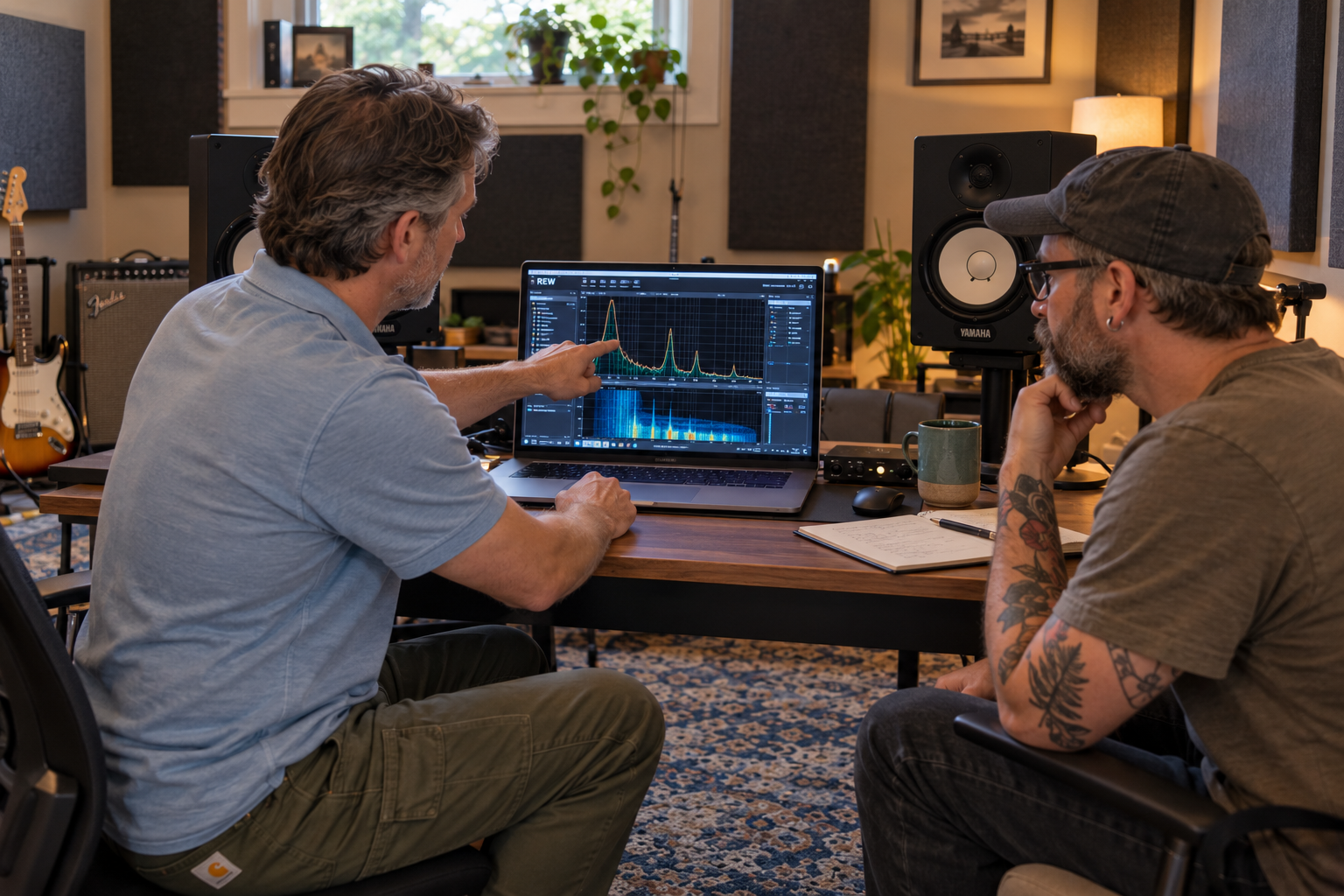
We use acoustic measurement tools, including Room EQ Wizard (REW) software and a calibrated measurement microphone, to examine how sound behaves within a room.
Measurements can help identify resonances, frequency-response irregularities, and the decay of sound over time.
We can also take follow-up measurements to evaluate the effects of treatment.
Not every room requires the same level of technical analysis, however. Sometimes careful listening and a straightforward assessment are sufficient.
-
Usually not.
In fact, it's often helpful to assess a room in the condition in which you normally use it.
Furniture, equipment, floor coverings, and other objects all influence its acoustics.
If temporary rearrangement or additional preparation would help with measurements or installation, we'll discuss that in advance.
-
Yes.
Our panels are individually fabricated, rather than purchased as finished products and resold.
This gives us flexibility in dimensions, materials, finishes, and installation details.
It also means that design and construction are closely connected: the person assessing the room is directly involved in creating the treatments intended to improve it.
-
Our service includes professional installation when required.
We can determine suitable mounting locations, fabricate the treatments, and install them as part of the project.
If you prefer to handle installation yourself, that’s fine — we can always discuss whether a supply-only arrangement makes sense for your particular situation.
-
That depends on the size of the room, the complexity of the treatment, and the number of panels required — as well as lead time if custom materials such as specialized fabrics are called for.
A modest home-office project may be relatively straightforward. A music studio with bass traps, wall panels, and ceiling clouds requires more planning and fabrication.
Once we've assessed your space and agreed on the scope, we can provide a realistic project schedule.
-
Every room is different, so there isn't a single useful price for a complete project.
Costs depend on the number and type of treatments, their dimensions, the selected materials and finishes, and the work required for installation.
We believe in explaining costs clearly and helping clients understand where their money will make the greatest difference. (We’ve been through these decisions ourselves.)
A modest, well-considered treatment plan can often be a better investment than filling a room with products that don't address its actual problems.
-
Absolutely — and in many cases, that's the most sensible approach.
We can identify the most important acoustic problems and prioritize treatments likely to make a meaningful difference.
Additional panels or bass traps can be considered later, particularly after we've had an opportunity to hear or measure the results of the initial work.
There is no requirement to do everything at once.
-
Third Act Acoustics is based in Dundas, Ontario, serving Hamilton, Burlington, Ancaster, Waterdown, and surrounding communities.
We generally focus on projects within approximately 50–75 kilometres of Dundas.
If you're a little farther away, though, feel free to get in touch. We can discuss whether your project is a good fit.
-
That's a perfectly good reason to contact us.
And you don't need to know the technical terminology or have a solution in mind to get the conversation started.
Tell us what you're experiencing, what you use the room for, and what you hope might be different.
We'll help you understand whether acoustic treatment is likely to be useful—and we'll say so if we think your problem calls for something else.
The goal isn't to sell you more panels. It's to help you make your room work better.
Have a question we haven't answered? We'd be happy to hear it.
“I would rather have questions that can't be answered than answers that can't be questioned.”
– Richard Feynman